
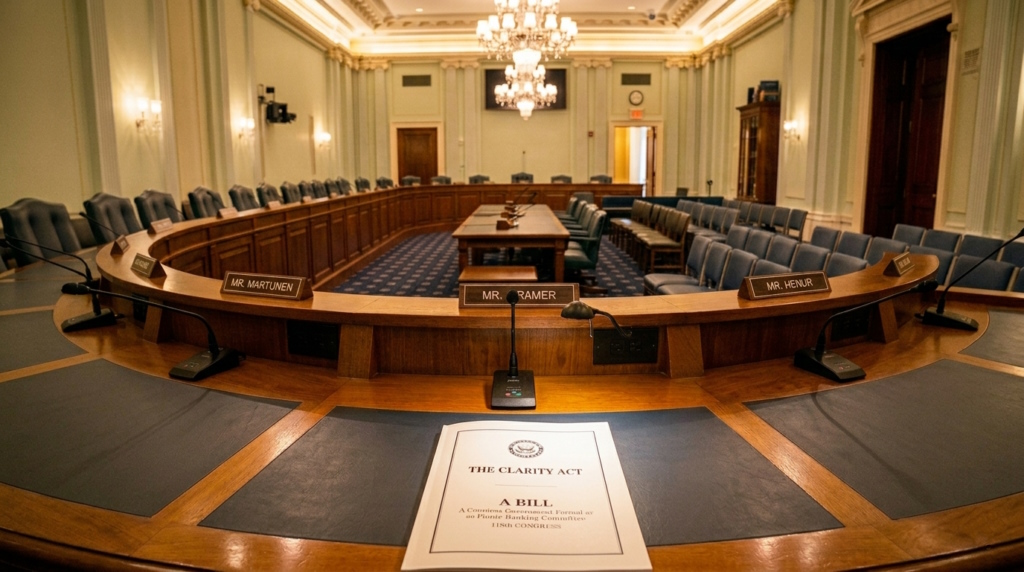
A coalition representing more than 100 cryptocurrency firms and industry bodies submitted a formal appeal to the Senate Banking Committee on April 23, 2026, calling for legislative action on digital asset regulation.
In their message, the group pressed Senators Tim Scott (R-S.C.), Elizabeth Warren (D-Mass.), Cynthia Lummis (R-Wyo.), and Ruben Gallego (D-Ariz.) to advance the Digital Asset Market CLARITY Act to the markup stage, emphasizing the urgency of establishing a coherent regulatory framework.
Let us take a deeper look at the letter, why it matters, and what changes it might bring in the future.
Moving Beyond Enforcement-Led Policy
According to the coalition, the current U.S. approach—largely shaped by enforcement actions from agencies such as the Securities and Exchange Commission (SEC) and the Commodity Futures Trading Commission (CFTC)—has resulted in inconsistent guidance and uncertainty for businesses. Rather than relying on case-by-case litigation to define boundaries, they argue, the Senate must step in to set clear statutory rules that can guide the market more predictably.
This reliance on enforcement has also had a chilling effect on innovation, as companies are often forced to operate defensively rather than strategically. In practice, that means resources are diverted toward legal risk management instead of product development, ultimately slowing the pace of technological progress in the sector.
Establishing Clear Legal Boundaries

As we have mentioned, at the center of this proposal is the Digital Asset Market CLARITY Act. It seeks to formally distinguish between digital commodities and assets classified as investment contracts. By codifying this separation, the legislation would delineate regulatory authority between the SEC and the CFTC, thus reducing overlap and ambiguity.
Although this bill has already passed the House of Representatives, progress in the Senate has been a lot slower. Negotiations have stalled as stakeholders attempt to reconcile differing views, particularly around whether stablecoins should be permitted to generate yield. This issue continues to divide traditional financial institutions and crypto-native companies.
The longer these disagreements persist, the more uncertainty compounds, making it increasingly difficult for both regulators and market participants to align their expectations.
Industry Heavyweights Lend Support
“Taking the current industry atmosphere into consideration, this letter is extremely notable for the breadth of its backing. Namely, major industry players such as Coinbase, Ripple, Circle, and Kraken have joined forces with investment firms like Andreessen Horowitz and Paradigm.”
Furthermore, they are accompanied by infrastructure providers and organizations such as Paxos, Galaxy Digital, Haun Ventures, Anchorage Digital, Consensys, and the Stellar Development Foundation.
It is also important to mention that the coalition includes state-level blockchain associations and university chapters affiliated with Stand With Crypto, underscoring that the push for regulatory clarity extends beyond corporate interests into academic and grassroots communities.
This all-around broader participation adds a different dimension to the conversation, suggesting that the outcome of this legislation could influence markets, education, research, and future workforce development alike.
Core Priorities Outlined
To support long-term growth and stability in the sector, the group outlined some of the key priorities that they view as essential for effective legislation. These include safeguarding incentives tied to payment stablecoins, clearly assigning regulatory responsibilities between agencies, and protecting developers who contribute to decentralized systems from unique enforcement risk.
In addition, they emphasized the importance of ensuring that any new federal rules are technically aligned with blockchain infrastructure, introducing disclosure requirements that are practical for companies to meet, and establishing consistent nationwide standards to avoid fragmented state-level regulation.
Without that alignment, even well-intentioned policies risk becoming ineffective or burdensome, particularly in a sector where technology evolves faster than traditional regulatory frameworks.
A Global Competitive Race
It is also good to mention that the letter warned that the lack of a unified federal framework could place the United States at a disadvantage. While domestic policymakers remain at an impasse, jurisdictions such as the European Union have already rolled out comprehensive regulatory regimes, creating more predictable environments for innovation and investment.
The group cautioned that, without decisive action, capital, talent, and technological development may increasingly shift to more accommodating regions. That would, in turn, have catastrophic consequences for the financial industry as a whole.
Over time, this could erode the U.S.’s influence in setting global financial standards, particularly in areas where digital assets and traditional finance are beginning to converge.
Conclusion
As of now, the Senate Banking Committee has yet to set a date for further consideration of the bill. Therefore, it remains to be seen whether this letter will actually accomplish anything and shift the conversation forward.
Still, regardless of its success, this coalition is a turning point in the Crypto world. If anything, it shows that big players can indeed work together to campaign for meaningful change.
More than 100 crypto firms urge Senate to move on U.S. market structure bill, https://www.coindesk.com/policy/2026/04/23/more-than-100-crypto-firms-urge-senate-to-move-on-u-s-market-structure-bill
CCI Joint Letter, https://cryptoforinnovation.org/wp-content/uploads/2026/04/Coalition-Letter-to-Senate-Banking-on-Market-Structure-Markup.pdf
Digital Asset Market CLARITY Act, https://www.congress.gov/bill/119th-congress/house-bill/3633/text
This site may reference or link out to external websites operated by third parties. These sites are independent from ADABA, and ADABA has no control over their content or activities. A link or mention should not be interpreted as an endorsement, partnership, approval, or recommendation of any third-party provider, nor does ADABA take responsibility for any of the products, services, or information they offer.
All content provided here is for general informational purposes only. Nothing in this material constitutes legal, tax, financial, or investment advice. Readers should seek guidance from qualified professionals before making decisions in any of these areas. ADABA accepts no liability for actions taken—or not taken—based on the use of the information provided here.
ADABA makes no representations or warranties regarding the accuracy, completeness, timeliness, or reliability of the information presented. We disclaim any responsibility for losses or claims arising from errors, omissions, or other issues contained in this material.