
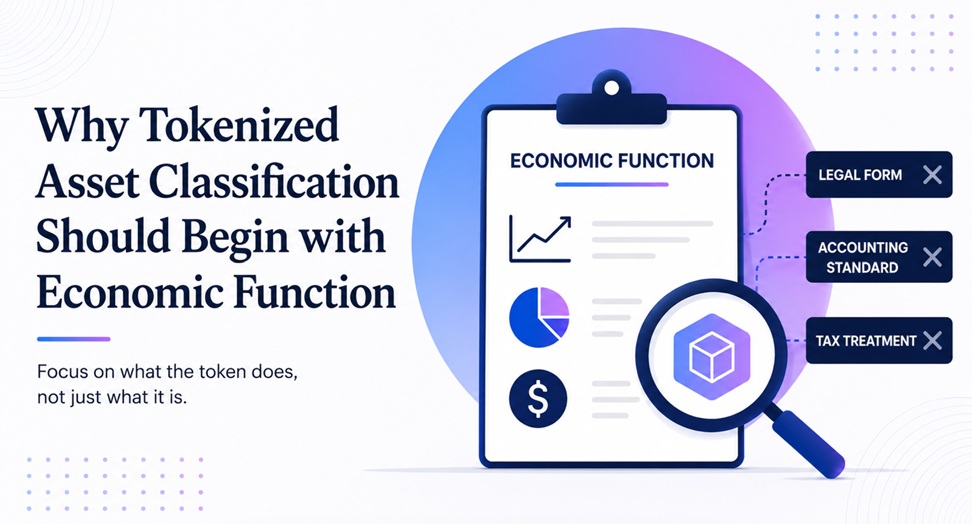
When an accountant receives a token to classify, the first question they ask is usually: which accounting standard applies to it? That question is entirely reasonable. However, it is also premature.
The same instinct guides them while doing legal reviews and tax analysis, with questions such as: what is the legal nature of the token? and how should the income be treated? popping up early on. While all of them are necessary questions, none of them should be an accountant’s first concern. Namely, if they treat it as their starting point, the results they get can remain internally coherent while resting on an entirely wrong foundation.
This is the central problem in tokenized-asset classification. The first error is rarely a legal, accounting, or tax error. In reality, the first error is analytical: the file simply begins in the wrong place.
Form Is Visible; Economic Function Is Decisive
A tokenized asset has a visible form: it consists of the token standard, the wallet record, the dashboard description, the smart-contract interface, and the commercial label. All of it is easy to identify. And yet, none of it reliably reveals what the token economically does.
The same form can create different economic positions. Two Non-Fungible Tokens may look identical on-chain, yet one is inventory held for resale, while the other is a prepaid right to access a service. Similarly, a tokenized real-estate position may be ownership, a contractual claim, a revenue participation, a governance right, or merely a platform-mediated entitlement. A ‘digital collectible’ may be exactly that, or it may carry contractual cash-flow exposure. The reverse holds too: economically comparable positions are routinely wrapped in very different technical and legal forms.
That variability is what makes form-first analysis fragile. If you begin with the label or the presumed accounting category, each discipline can complete its own workstream while the file as a whole describes no single underlying position.
The ELFT Sequence
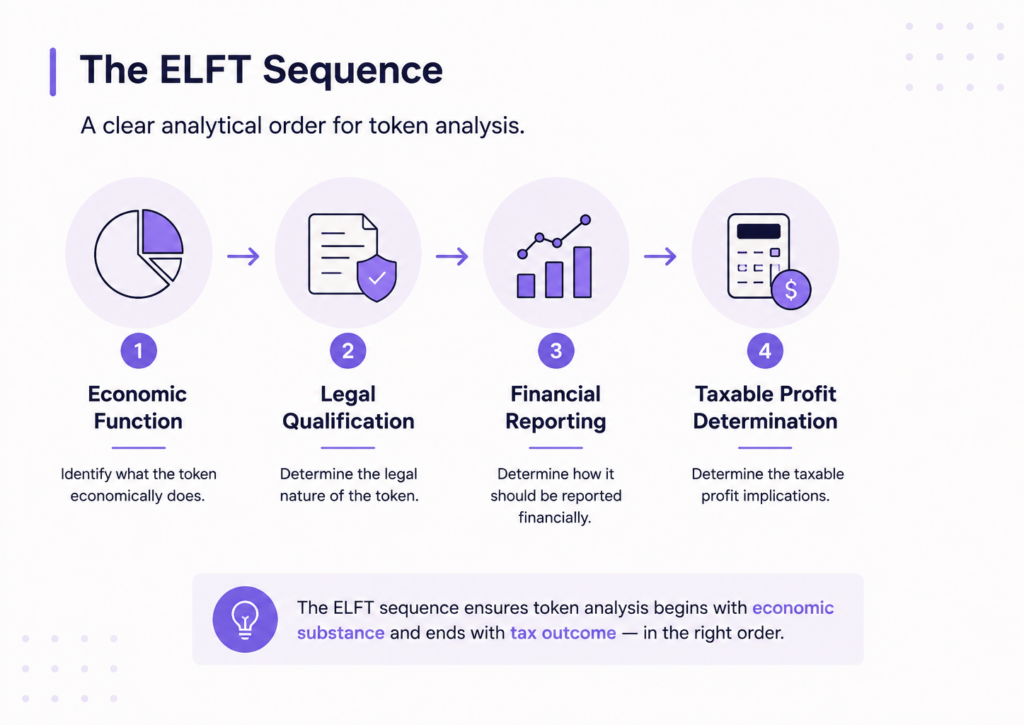
One way of addressing this issue is using the ELFT sequence. This sequence fixes the analytical order by giving accountants a clear-cut plan of token analysis:
Economic Function → Legal Qualification → Financial Reporting → Taxable Profit Determination.
The order is essential because all four layers are dependent. Financial reporting turns on legally enforceable rights, control, exposure to risks and rewards, and the business model. Taxable profit determination typically starts from the financial statements and then applies tax-specific corrections. Therefore, if the first layer is faulty or undocumented, the subsequent layers inherit that weakness.
It is important to say that ELFT does not replace legal doctrine, financial reporting analysis, or tax analysis—it simply disciplines their order. Everything begins with one question: what economic function does the tokenized position perform in its concrete context of use? Answering it entails identifying the economic exposure, cash-flow profile, value drivers, risk allocation, transfer effects, redemption mechanics, custody structure, and counterparty dependence that is actually in play.
Only then does legal qualification begin; only then can the financial reporting treatment be selected and tested; only then is the tax position assessed on a coherent basis. When the order is fixed, the conclusions stay discipline-specific.
A Practical Example: The Collectible That is Not Merely a Collectible
It is smart to analyse this with a practical example.
Let us say we have a company that acquires tokens marketed as digital content collectibles. The dashboard shows images and collectible numbers, and the tokens trade on a secondary marketplace. On that basis, the accounting file may comfortably open with the conclusion that the company holds digital collectibles. But the token terms contain a less visible clause: each token entitles the holder to a pro-rata share of net licensing revenue from an IP catalogue, distributed quarterly, by an identifiable legal entity, under a specified governing law. Two routes now diverge from the same facts.
Form-first, the legal review asks whether the token is a regulated instrument. The answer—that it is a non-regulated digital collectible—reaches the accounting team as a collectible file. At this point, the default question becomes whether it is an intangible asset. The tax team follows the accounting and books the distributions as generic other income. Every step looks reasonable, but the revenue-participation feature is never properly tested.
On the other hand, under ELFT, the first question is not what the token is called but what the position does. Economically, the holder participates in a variable income stream generated by another party’s IP. The collectible wrapper is form; the function is revenue participation. That changes the legal question into: what enforceable rights exist, against whom, and under which framework? In turn, the answer changes the financial reporting analysis: an enforceable right to cash from an identifiable counterparty may require financial-asset analysis rather than a default intangible-asset analysis, with consequences for measurement, fair value, credit risk and profit or loss. And the tax analysis shifts as well: timing, character and valuation all become different questions.
The facts have not changed: the analytical entry point has. That is the point. The divergence is not introduced at the moment of classification; it is introduced at the moment the analysis begins.
Why Labels Are Especially Dangerous for Accountants and Tax Professionals
For accountants and tax professionals, token labels are dangerous precisely because they make complex positions look familiar too early. An NFT can raise inventory, intangible-asset, prepayment, revenue, financial-instrument or disclosure questions. A tokenized real-world asset can require analysis of control, rights, obligations, derecognition, consolidation or impairment. A platform token can combine access, governance, consumption and speculative exposure at once. None of that is clear from the label alone.
The accounting reflex to ask which standard applies? is still right—it is just premature. For a technical-accounting lead or an audit partner, the test is not whether each discipline can defend its own conclusion, but whether all of them started from the same documented economic-function conclusion. For advisers, the risk is both misclassification and an audit, tax and governance file that cannot explain why—and how—its layers belong together.
Conclusion
ELFT does not produce a single universal classification, as tokenized assets remain fact-specific and jurisdiction-sensitive. Its value is a shared starting point: it requires legal, accounting and tax teams to work from the same documented economic-function conclusion before each applies its own framework.
That is what makes inconsistency visible. If the legal memo describes a contractual claim, the accounting file treats the position as a collectible, and the tax analysis tells a third story, the problem is no longer technical. The file lacks cross-layer alignment.
A defensible file therefore does more than state conclusions. It documents the path to them: how the economic function was identified, how the rights and obligations were qualified, how the reporting treatment was selected, and how the tax consequences followed. Without that path, alignment is not demonstrated.
Thus, the question for any team working with tokenized positions is not whether each discipline can defend its conclusion in isolation; it is whether all of them began from the same documented economic-function conclusion. If not, they will only be able to assume consistency, not actually demonstrate it.
Tokenized Assets Research
An independent research platform focused on the legal, financial reporting, and tax treatment of tokenized assets.
This site may reference or link out to external websites operated by third parties. These sites are independent from ADABA, and ADABA has no control over their content or activities. A link or mention should not be interpreted as an endorsement, partnership, approval, or recommendation of any third-party provider, nor does ADABA take responsibility for any of the products, services, or information they offer.
All content provided here is for general informational purposes only. Nothing in this material constitutes legal, tax, financial, or investment advice. Readers should seek guidance from qualified professionals before making decisions in any of these areas. ADABA accepts no liability for actions taken—or not taken—based on the use of the information provided here.
ADABA makes no representations or warranties regarding the accuracy, completeness, timeliness, or reliability of the information presented. We disclaim any responsibility for losses or claims arising from errors, omissions, or other issues contained in this material.