

Decentralized autonomous organizations (DAOs) were historically built on the promise of radical transparency. On paper, they are picture perfect, based on a model in which treasury movements are visible on-chain, governance decisions are permanently recorded, and capital allocation unfolds in full public view. In such an environment, nothing is concealed: every transfer leaves a trace, and everything is recorded in a 100% auditable history.
However, transaction-level transparency does not automatically translate into financial clarity. In fact, when we examine DAO grants through an accounting lens, the apparent simplicity of on-chain transfers begins to unravel at a breakneck speed. Namely, many obligations are simply implied rather than formalized, and token-based payments often move across jurisdictions without the documentation infrastructure that traditional finance systems typically rely on to establish any semblance of economic substance.
Put simply, there is a widening gap between how decentralized communities distribute capital and how financial, tax, and regulatory frameworks expect that capital to be classified and reported. With DAO treasuries expanding and the institutional attention on them intensifying, this gap becomes more and more difficult to ignore.
In the sections that follow, we will examine the reality behind DAO grants and all the risks and challenges that accountants and auditors face when trying to classify and analyze them.
DAO Grants In Practice
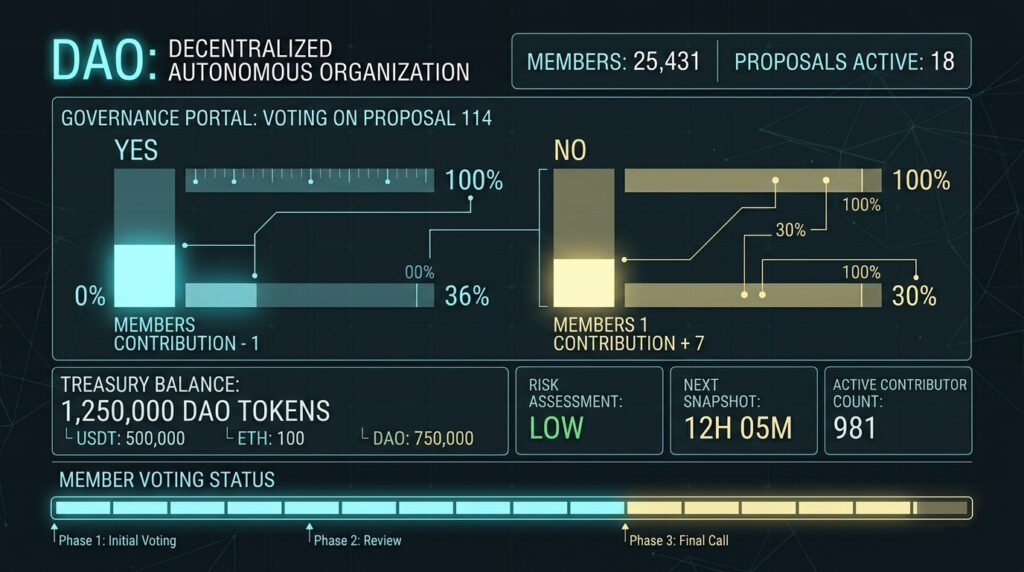
In operational terms, DAO grants can appear deceptively simple. There is a treasury that holds native governance tokens, stablecoins, or any other type of digital assets. Then, a contributor submits a proposal outlining a project—anything from protocol development and research to marketing initiatives. The token holders take a vote and, if the proposal passes, a multisig wallet executes the transfer.
The process seems just as straightforward from a blockchain perspective. Namely, the transaction hash confirms the amount, timestamp, and destination wallet, and then the public ledger provides immutable proof that the funds have moved in the direction they were supposed to.
What is the issue, then? Well, the ledger does not capture everything. In reality, the full economic context of the transfer is often missing. In many cases, there is no signed agreement that specifies deliverables or milestones. At the same time, the only information that can identify the counterparty is a wallet address or a pseudonym.
In addition, invoices are not that common, and documented confirmations aren’t really the norm. Add in the fact that some grants are retroactive—rewarding work that has already been completed without any prior contractual obligation—and matters become even messier.
To simplify, the blockchain records the movement of value. However, it does not take note of the legal relationship, the performance criteria, or the accounting classification of said movement.
For financial reporting purposes, those omissions matter a lot.
The Classification and Volatility Issues
Traditional accounting systems typically rest upon a seemingly simple question: what is this payment? The answer determines how that payment is measured and disclosed.
In the context of DAO grants, this query often resists any type of straightforward resolution.
Let’s take a grant awarded to developers building core protocol infrastructure as an example. Though this type of work might resemble research and development, it actually materially enhances the long-term functionality of a network. As such, we can say that it creates an intangible asset.
Liquidity incentive programs raise a similar issue. From one point of view, they resemble marketing expenses designed to attract users. But from another, they function more like financial instruments intended to deepen market liquidity and stabilize trading conditions.
Tooling grants introduce yet another level of complexity. Namely, when such grants produce reusable software or developer tools, they can be interpreted as capital investments in infrastructure instead of operating expenses. That is especially the case where the resulting assets continue to generate value and revenue long after the grant has been distributed.
In short, the problem with all three examples is that they lack at least one element that accounting frameworks require. In these cases, that can be either a clearly identifiable counterparty, a defined performance obligation, or a reliable method of measurement. Without one of these elements, classifying an expenditure with confidence becomes quite tricky.
Unfortunately, the issues do not cease here, as we also have to consider the problem of valuation.
Namely, grants are often denominated in native governance tokens. Their market price can fluctuate significantly between the dates of the proposal approval and the actual payment. This problem can happen even if the money is transferred promptly, as the value can change dramatically quickly. In addition, setting the fair value for the payment requires a healthy dose of judgment. After all, it’s necessary to decide whether the value should be measured at the token’s price at approval, at transfer, or over a vesting period.
In other words, volatility shapes reported financial performance. In such circumstances, the same type of grant can produce materially different accounting outcomes from one reporting period to the next, all because there is an absence of clear policies and consistent application.
The Documentation Void

Now, it is important to note that even if classification and valuation weren’t an issue, there is an even more fundamental problem: documentation. Namely, in typical circumstances, auditors have to check both whether a transfer happened and whether the transaction was supported by sufficient and appropriate proof of economic substance.
Usually, that evidence includes invoices, contracts, proof of deliverables, and verified counterparty identities. However, what most DAOs can offer are functional equivalents such as governance forum posts, public chat discussions, and Snapshot votes. While they do indeed demonstrate community intent, they do not actually satisfy the documentation standards expected in formal financial reporting.
The absence of structured agreements complicates the ability to substantiate the purpose of an expense. For one, when counterparties use pseudonyms, related-party transactions can be obscured behind wallet addresses. That can, in turn, make it difficult to assess dependence or any conflicts of interest. Furthermore, retroactive approvals may blur the line between authorized disbursement and discretionary transfer.
To put it all simply, while blockchain transparency reveals the flow of funds, it does not automatically establish compliance with internal controls. Therefore, there is often a clear distinction between visible and auditable transactions. With time, this distinction becomes more and more consequential.
Tax and Regulatory Exposure
DAO grants also have a cross-border nature, which complicates matters even further. Namely, contributors may reside in multiple jurisdictions, and they usually make payments in tokens rather than in fiat currency. In many instances, there is no withholding mechanism, nor are any tax forms issued.
From a tax perspective, these situations are quite problematic. For one, there is the question of whether these payments are compensation for services. If so, who is the actual payer? Does a legal entity stand behind the DAO, or does the decentralized structure complicate attribution? In addition, how should token-based compensation even be valued for income reporting, particularly when market prices fluctuate so often?
The answers to these questions depend on whether the DAO operates through a formal foundation or an incorporated entity. To that end, regulators seek identifiable responsible parties, ownership transparency, and financial statements that conform to recognized standards.
Therefore, the risk with these types of transfers is not limited to theoretical noncompliance alone. With time, inconsistent grant accounting and insufficient documentation could be interpreted as systemic governance weaknesses.
The Accounting Blind Spots
As we have already mentioned, DAO grants can fall into different categories and have various structures. Some of these structures magnify the aforementioned tensions.
For example, retroactive public goods funding rewards contributors after some type of work has already been completed and assessed by the community. This model complicates expense recognition. Namely, if no enforceable obligation existed at the time the work was performed, it becomes difficult to determine when the liability arises. After all, recognizing the expense too early comes with a risk of overstating obligations, and recognizing it only upon approval may obscure that the work benefited the protocol even before the recording took place.
“All in all, it’s important to recognize that traditional accounting systems were not designed for governance-triggered, market-sensitive transfers whose value can fluctuate dramatically.”
It is for that reason that these innovative funding mechanisms remain accounting blind spots.
Toward Structured Grant Governance
You might be wondering, how can all of these issues be solved to allow for better accounting practices when it comes to DAO grants? The key is in professionalisation.
In practice, that means creating structures that translate community-driven decisions into arrangements that can withstand financial and legal scrutiny alike.
One possible approach to bridging this gap is the use of standardized grant templates that define deliverables, timelines, and payment conditions, while leaving the funding decision itself to on-chair governance. Plus, milestone-based transfers can further strengthen accountability, especially if smart contracts release funds as work is completed and off-chain documentation includes all the records that auditors require. Certain DAOs also rely on independent treasury or grant committees to review allocations and monitor spending without removing the community’s overall role in governance.
In most cases, these mechanisms operate within hybrid structures. For example, governance does still determine which projects receive funding, but formal agreements are executed through legal entities. Similarly, treasury management tools are also being integrated with accountancy systems, which creates clearer audit trails and still preserves the transparency of on-chain transactions.
Therefore, and contrary to popular belief, the aim isn’t to introduce unnecessary bureaucracy. Instead, it’s to ensure that decentralized capital allocation can withstand scrutiny from auditors, regulators, and institutional stakeholders alike.
Conclusion
To this day, DAO grants remain one of Web3’s most compelling innovations. They enable programmable, community-directed capital allocation on a global scale. And yet, the visibility of the transactions does not automatically translate to auditing and accounting clarity.
With treasuries expanding and external expectations rising, the experimental nature of these grants clashes with the structural demands of financial reporting and regulatory oversight. Though they accumulate quietly, classification ambiguities, valuation volatility, and documentation gaps are still a huge problem that makes flexibility appear as risk.
Therefore, the next phase of DAO evolution will depend on whether decentralized organizations can align their on-chain transparency with off-chain accountability. With regulations tightening and auditors and accountants becoming more and more involved, this step will be especially crucial.
- Ugochukwu, Esther & Falaiye, Titilola & Mhlongo, Noluthando & Nwankwo, Ezinwa. (2024). Accounting for digital currencies: A review of challenges and standardization efforts. International Journal of Science and Research Archive. 11. 2438-2453. 10.30574/ijsra.2024.11.1.0317.
- Wu, C., & Zhou, Z.-J. (2022). The Impact of Digital Currency on Accounting and Management under the Blockchain Architecture. International Journal of Education and Humanities, 5(3), pp.23-27.
- Smith, S., & Castonguay, J. (2019). Blockchain and Accounting Governance: Emerging Issues and Considerations for Accounting and Assurance Professionals. Journal of Emerging Technologies in Accounting, 17(1), pp.119-131. Steakhouse Financial on Financial Reporting for DAOs.
- Decetraland, on DAOs.
- Lemma. The World of Decentralized Voting.
This site may reference or link out to external websites operated by third parties. These sites are independent from ADABA, and ADABA has no control over their content or activities. A link or mention should not be interpreted as an endorsement, partnership, approval, or recommendation of any third-party provider, nor does ADABA take responsibility for any of the products, services, or information they offer.
All content provided here is for general informational purposes only. Nothing in this material constitutes legal, tax, financial, or investment advice. Readers should seek guidance from qualified professionals before making decisions in any of these areas. ADABA accepts no liability for actions taken—or not taken—based on the use of the information provided here.
ADABA makes no representations or warranties regarding the accuracy, completeness, timeliness, or reliability of the information presented. We disclaim any responsibility for losses or claims arising from errors, omissions, or other issues contained in this material.